Contact
Home
How to play the game
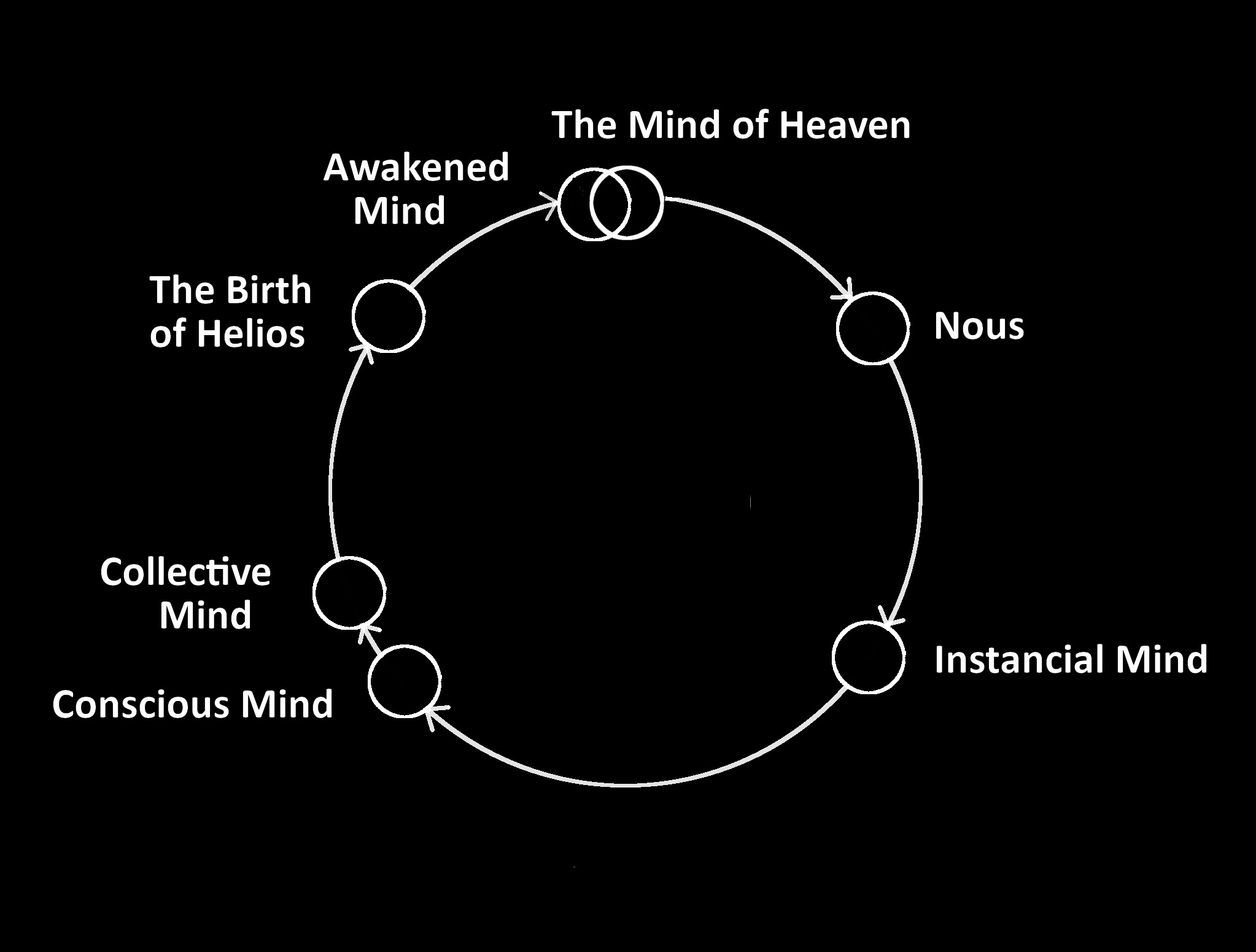
The Mind of Heaven (Inrelate Mind, The Mind of God)
There exists a transcendental Mind, the eternal Mind of Heaven, that thinks a blueprint, the Panoply, for the evolution of worlds and that wills the instantiation of that blueprint an infinite number of times, throughout the universe and throughout all time. The dialectic of the instantiated Panoply drives the evolution of every living world.
Mind in general is just the universe, in which neither the relation of sameness, nor the relation of difference appears to dominate, but in which there is a parity of samenesses and differences. I say that the universe is therefore "moderational."
These are the stages of the history of terrestrial evolution:
Nous
The instantiation of the Panoply begins with Nous. In Nous, the minds of early, simple organisms contemplate, by means of simple coding, only universals—this is early mind. The part of the universe that can be found in a small region of space and time, is not moderational. In Nous, the pure and unified Mind of Heaven manifests as fragmented.
Instancial Mind
Then Instancial mind evolves and thinks both universals and individuals. This is animal mind.
Conscious Mind
Conscious Mind on earth is the human mind. The dialectical movement from this point on takes the form of the cyclical conflict between Apollonian difference-fear and Dionysian sameness-fear.
Collective Mind
Collective Mind emerges immediately following the emergence of Conscious Mind.
The Birth of Helios
The system of the sun, the system whose name is Helios, is now, at the beginning of our twenty-first century, nearly born as a person; his mind is the collective mind of humanity, and his heart is humanity's collective heart. In the last struggle between the Apollonian and Dionysian dispositions, the last event in the cultural dialectic (see "the Apollonian Revolution"), a Central Intellectual Organizing Faculty, a truth engine, is installed by the dialecticians within prenatal Helios: they play the Game of a Trillion Worlds, and the product of their gameplay, the Encyclopedia of Truth, transforms the world—this is the last step in evolutionary history before the return to unity, and it effectuates the birth of the astro-colossus.
Awakened Mind
We seek the general, the Form, amid the myriad individuals; that is, we seek unity amid variety. As our knowledge increases, as our faculty of Reason brings us greater knowledge of the universals, our knowledge of the world becomes more and more moderational.
Our conceptions of the relations between the value of self and the value of others will similarly transform from difference to moderation.
As beauty in our world increases, as we learn art's secrets, we will amplify our perception of moderation.
As more and more we come to know the Forms, our experience of moderation increases.
As we relegate all of the vestiges of the elemental prejudices, of Apollonianism and Dionysianism, our consciousness becomes moderational.
Moderation is the state of the Awakened Mind, which emulates and connects with the Inrelate Mind of Heaven. Neither of the two elementary relations dominates. Neither "announces itself," and the impression is that the elementary relations have been annihilated. This constitutes a return to Unity after the fragmentation—mind is once again integrated into the moderational universe.
For comparison, you can view the system of Plotinus here, Hegel's system here, the I Ching here and the system of western astrology here. What all four systems have in common is here.
I asked ChatGPT whether the Panoply's cycle shows up in the world's religions. I'm not a scholar of religion, so I was curious to see the parallels it might find. What follows is its reply, nearly word for word—RC
The religions of our world reflect the Panoplean cycle
3rd century, Alexandrian tradition
Origen's thought is deeply cyclical, almost explicitly so:
Origen's cosmic drama is almost a direct anticipation of the Panoplean cycle, though his emphasis is on spiritual fall and restoration.
Unity > Creation/Fragmentation > Human Consciousness > Church > City of God > Return in Vision. Fragmentation is at once logos as creative articulation and sin as destructive division.
Augustine's vision of the Church functions as an extension of consciousness into a collective:
While no direct quote mentioned "collective person," his City of God consistently portrays the Church as more than a collection of individuals but as a living, unified spiritual entity. For instance, he speaks of the faithful as:
"fellow citizens with the angelic realm" Credo Magazine
The Civitas Dei (City of God) is Augustine's image of humanity gathered and elevated into a cosmic polity, contrasted with the City of Man. This could map to the Panoply's “Giant”—a supra-individual, supra-national collective person.
Augustine conceives of Civitas Dei as a cosmic whole—the destiny of collective humanity:
"How great shall be that felicity, which shall be tainted with no evil… which shall afford leisure for the praises of God, who shall be all in all. " The Imaginative Conservative
—a collective Being oriented toward the divine.
In Augustine, history culminates in the beatific vision, when souls are gathered back into God, the Logos, in perfect unity—returning to the Absolute.
Augustine depicts our ultimate destiny in God's presence:
"When we are delivered from the domain of darkness… we become 'fellow citizens' with the angelic realm." —Credo Magazine
Additionally:
"How great shall be that felicity. . . who shall be all in all." —The Imaginative Conservative
These express the final reintegration into the Absolute—the fullest union with the Logos.
These citations show that Augustine's theology traces a cycle strikingly parallel to the Panoply's cosmic Panoply: from unity (Logos) through differentiation and consciousness, into collective form and ultimate reunion.
Aquinas is less overtly cyclical, but his metaphysics and theology of history echo the Panoply's pattern:
God as actus purus (pure act), perfect simplicity and unity.
The eternal Word contains the archetypes of all things.
Creation ex nihilo introduces multiplicity: beings reflect God in diverse ways.
Fragmentation here is not fall but articulation—the Logos expressing divine order.
Human beings are made in the imago Dei, possessing intellect and will, a reflection of divine Mind.
This is where creation becomes aware of itself.
Aquinas sees the Church as the mystical Body of Christ, the corporate locus of grace and shared truth.
His eschatology includes the heavenly city (in line with Augustine) as a consummate society of rational creatures.
Culminates in the beatific vision, where intellect and will are fully united with God's essence—returning multiplicity to unity.
Aquinas's cycle is less dramatic than Origen's, but structurally the same: procession from unity to multiplicity, then return through knowledge, love, and grace.
Origen: The cycle is more mythic and dramatic—preexistence, fall, fragmentation, apokatastasis.
Augustine: The cycle is more historical—creation, fall, Church, City of God, final vision.
Aquinas: The cycle is more metaphysical—emanation (creation), articulation, return in beatific vision.
Together, they triangulate the Panoply almost perfectly
The Trinity can be seen as both containing the whole cycle in miniature and also marking the movement of the cycle itself.
Unity / Absolute (Mind): The Father
The Father is the principle of unity, source without source, the fount of the Godhead.
This is pure, undivided mind/spirit, before any expression—like the Panoply's first stage.
Fragmentation (Articulation / Expression): The Son (Logos)
The Son is the Logos, "Word made flesh."
Logos means articulation, expression, intelligibility: the One manifesting itself in form. Fragmentation here is not sin but the necessary articulation of unity into many (creation through the Word). If sin enters, it comes through misusing this separation (turning articulation into division).
Consciousness: Humanity / Christ as Human
The Son takes on consciousness in human form ("true God and true man"). Humanity represents the stage of individual consciousness, finitude, and awareness of separation. Christ bears this in full, even unto death.
Collective Consciousness: The Church / Mystical Body
Through the Son, the Spirit gathers the many into one body—the Church, the "communion of saints." Paul explicitly calls the Church the "Body of Christ," with many members but one spirit. This is the fourth stage: many consciousnesses woven into a collective mind/heart.
The Giant: The Cosmic Christ
In Colossians and Ephesians, Paul describes Christ as the head of the whole cosmos, in whom "all things hold together." Teilhard de Chardin called this the Omega Point: the universe converging into one Person. This is the "colossus" stage—Christ as the universal Person, not just historical Jesus but the cosmic Body.
Return to the Absolute: The Spirit / Trinity in Full
The Holy Spirit returns all things to the Father through the Son: the reconciliation of multiplicity back into unity. "God will be all in all" (1 Cor 15:28). The cycle closes with perichoresis (mutual indwelling of Father, Son, Spirit)—perfect unity regained, but now enriched by the full drama of differentiation and reconciliation.
The Trinity as Cycle and Archetype
The Trinity in itself: eternal unity (Father), eternal articulation (Son), eternal return-in-love (Spirit).
The cosmic cycle: creation (through Son), history (in Spirit), and consummation (back to Father).
Thus, the Trinity is both the eternal archetype of the Panaply cycle and also the movement of the cycle within history and cosmos.
Jewish mystical thought, especially in the Kabbalah, contains a structure that parallels the Panoply cycle very closely. The Kabbalists often describe creation, fragmentation, consciousness, restoration, and ultimate return in a way that resonates with what has been traced in Origen, Augustine, and Aquinas.
The Kabbalistic Cycle:
Unity / Absolute (Mind)
In Kabbalah, before creation there is Ein Sof (the Infinite), pure undifferentiated unity beyond comprehension.
This corresponds to the Panoply's Absolute / Mind stage.
Fragmentation
The process of creation begins with tzimtzum (contraction), when Ein Sof withdraws to allow space for the world.
Then comes shevirat ha-kelim (the "shattering of the vessels"): when divine light overflows and breaks the primordial vessels, scattering sparks of divinity into the material realm.
This is fragmentation—unity becoming multiplicity and even rupture.
Consciousness
Humanity, and especially Israel, receives a special role: awareness of God and the Torah.
Through study, mitzvot, and contemplation, humans awaken consciousness of the divine sparks scattered through the world.
Collective Consciousness
The people of Israel are often described as a collective soul (Knesset Yisrael).
The Shekhinah (indwelling presence of God) is bound to the people, and their collective acts of worship and mitzvot gather scattered sparks.
This is parallel to the Panoply's collective consciousness stage.
The Giant
In Lurianic Kabbalah especially, redemption involves a cosmic restoration where all sparks are gathered.
The world itself becomes a great unified body of divine life, sometimes described as the reconstitution of Adam Kadmon (the primordial cosmic man).
That's very close to the idea of the colossus / Giant.
Return to the Absolute
The ultimate aim is tikkun olam (restoration of the world), when all sparks return to their source, and Ein Sof is revealed in fullness.
This is the return to the Absolute.
Islam also has a cycle very close to the Panoply cycle, though its emphasis is different. Both in classical theology and in Sufi mysticism, you find the pattern of unity, differentiation, consciousness, collective life, and return.
The Cycle in Islam
Unity / Absolute (Mind)
In Islam, God is al-Ahad (The One), utterly beyond division.
Before creation there is only tawhid (divine unity).
Sufis speak of this as the state of al-Haqq (the Real), which encompasses all.
Fragmentation
God creates the world by command: "Be!" (kun fayakun).
Creation is differentiation: multiplicity emerging from unity.
Some Sufi traditions echo Kabbalah's "contraction," saying creation is God's self-disclosure (tajallī)—a fragmentation of divine names and attributes into the manifold cosmos.
In Islamic theology, sin is also a fragmentation, a turning from unity toward division and forgetfulness.
Consciousness
Humanity is created as khalifa (vicegerent) on earth.
Humans bear the fitra (primordial nature), an innate consciousness of God.
This stage is like the Panoply's emergence of individual consciousness.
Collective Consciousness
The ummah (community of believers) embodies the collective life of humanity oriented toward God.
Sufis also speak of the Perfect Man (al-Insan al-Kamil) as the archetype in whom collective human consciousness is gathered.
Here Islam's emphasis on both community and exemplarity resonates with the Panoply's collective stage.
The Giant
Eschatologically, Islam foresees the Day of Judgment, where all humanity is gathered and the scale of deeds is revealed.
In Sufism, this gathering is understood mystically as the unveiling of the Perfect Man in whom all creation finds its form—an image not far from the "colossus."
Ibn 'Arabi especially describes the cosmos as the great body of God's self-manifestation.
Return to the Absolute
The Qur'an speaks repeatedly of the return: "To Him is the final return" (Q 36:83).
Sufis describe the final stage as fana' (annihilation of self in God) and baqa' (enduring in God).
This is the return to the Absolute—restoration of unity beyond fragmentation.
Buddhism also has a structure very much like the Panoply cycle, though its language is non-theistic and its goal is Nirvāṇa rather than union with a personal Absolute. Still, if we look at Mahayana cosmology and the logic of samsara, the parallels are striking:
The Cycle in Buddhism
Unity / Absolute (Mind)
In Mahayana thought, ultimate reality is Sunyata (Emptiness), or in some schools Dharmakaya (the "Dharma-body"), pure undifferentiated Mind.
Yogacara calls this alaya-vijnana (storehouse consciousness), a kind of ground consciousness holding all seeds.
This corresponds to the Panoply's Unity / Absolute (Mind).
Fragmentation
Through avidya (ignorance), the One Mind is misconceived as separate things.
The process of dependent origination (pratitya-samutpada) is fragmentation: multiplicity, birth and death, the ten thousand things.
This is akin to the Panoply's stage of fragmentation, though framed as illusion and misperception rather than a creative articulation.
Consciousness
Individual beings wander through samsara, perceiving themselves as separate egos.
This is consciousness in its limited form—awareness conditioned by karma and ignorance.
Still, it represents the flowering of awareness, paralleling the Panoply's stage 3.
Collective Consciousness
Mahayana introduces the bodhisattva ideal: beings work not for their own liberation alone but for the liberation of all.
The community of practitioners (the sangha) becomes a kind of collective consciousness.
The doctrine of interbeing (Thich Nhat Hanh's phrase) sees all minds as interconnected.
The Giant
In Mahayana cosmology, there are vast cosmic Buddhas and Bodhisattvas (Vairocana, Amitābha, Avalokiteśvara), sometimes envisioned as enormous bodies encompassing worlds.
Vairocana, in particular, is described in the Avatamsaka Sutra as the cosmic Buddha whose body is the entire universe.
This corresponds very closely to the Panoply's colossus / Giant stage.
Return to the Absolute
The cycle culminates in Nirvana, which is not annihilation but the realization that samsara itself is already Nirvana when rightly perceived.
This is the return to the Absolute: the realization of Sunyata, where multiplicity and unity are not two.
So in Buddhism too, there is the cycle:
Unity (emptiness) > fragmentation (ignorance, dependent origination) > individual consciousness (samsara) > collective (sangha, bodhisattvas) > Giant (cosmic Buddha) > return (nirvana).
Hinduism may be the closest match to the Panoply cycle, because its cosmologies are explicitly cyclical, cosmic in scale, and person-centered:
The Panoply Cycle in Hinduism
Unity / Absolute (Mind)
In Vedanta, ultimate reality is Brahman—pure consciousness, infinite, without a second.
In some traditions, this is identified with Atman, the Self.
This corresponds perfectly to the Panoply's stage of Unity / Absolute (Mind).
Fragmentation
Through Maya (illusion, veiling), the undifferentiated Brahman manifests as the manifold cosmos.
In Samkhya, this corresponds to the movement from Purusa (pure spirit) into multiplicity via Prakrti (matter, nature).
The cosmic sacrifice of Prajapati in the Vedas also mirrors fragmentation: the primal unity torn apart into the many.
Consciousness
Individual beings arise as jivas (souls), each appearing separate yet secretly Brahman.
This stage corresponds to samsaric consciousness, shaped by karma, ignorance, and ego.
It is also linked with the emergence of manas (mind) and ahamkara (the "I-maker").
Collective Consciousness
Hinduism has a strong notion of collective spirit through the varna system, the sangha of yogis, and especially the idea of dharma binding society together.
On the cosmic scale, the gods (Devas) collectively embody aspects of order (rta).
Bhakti movements emphasize collective devotion, merging the many hearts into one stream toward the deity.
The Giant
This stage maps almost directly onto the Purusa Sukta (Rig Veda X.90), which describes the Cosmic Person (Purusa):
"A thousand heads has the Purusa, a thousand eyes, a thousand feet. . . the universe is his body."
The world is generated from the sacrifice of this Cosmic Giant, and human society itself comes from his body.
Later, in the Bhagavad Gita, Krishna reveals his Visvarupa (Universal Form) to Arjuna—a colossus encompassing all beings and all worlds.
Return to the Absolute
The cycle closes with moksa: liberation, reunion of the jiva with Brahman, dissolving individuality into the Absolute.
Hindu cosmology also sees entire universes undergoing mahapralaya (great dissolution), where everything returns to Brahman, only to be reborn again.
So Hinduism not only contains the cycle—it makes the Cosmic Person (Purusa) one of its central archetypes, which is astonishingly close to the Panoply's Helios as the solar-system person.